


What the FIFPRO Global Employment Report reveals—and how evidence drives systemic action
The global commercial boom in women’s sport is undeniable. High-profile international tournaments, breaking attendance records, and growing broadcast revenues signal unprecedented momentum. Yet, as the FIFPRO Global Employment Report 2026 demonstrates through empirical data from over 40 countries, economic growth does not automatically translate into institutional protection, fair working conditions, or sustainable career pathways.
For ENOSS, the report‘s findings coming out of Women’s Football are more than statistics—they are another clear call for further structural reforms across both elite and grassroots environments.
KEY FINDINGS
The report paints a stark picture of a two-tier sport ecosystem where headline growth hides widespread precarity:
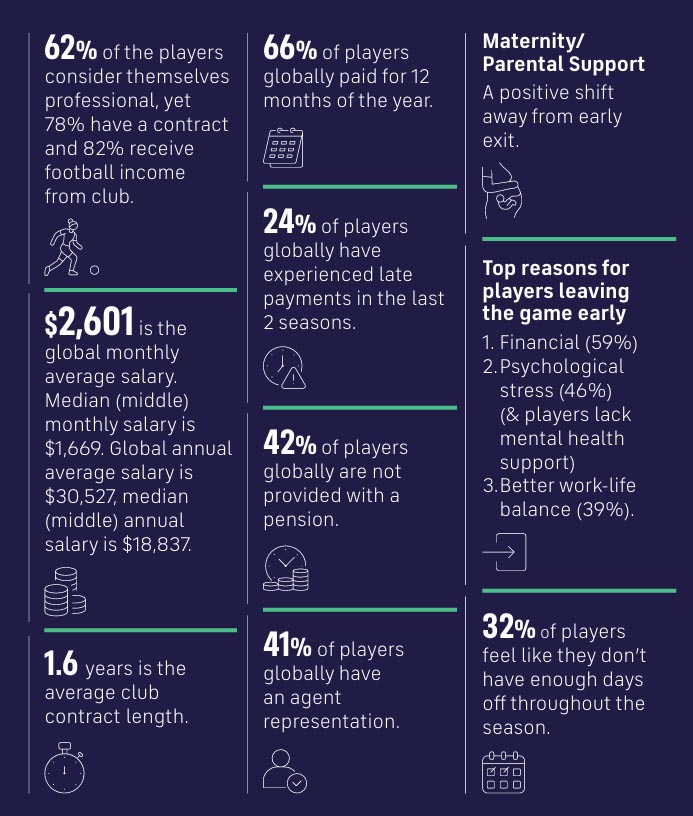
- Growth without a floor: While global revenues soar, 42% of professional female players lack pension provision, and nearly a quarter experienced delayed payments in the last two seasons. Growth at the top is not trickling down into structural security.
- Mental stress and early career exit: Beyond financial instability (59%), psychological stress (46%) and the search for work-life balance (39%) are leading reasons why athletes leave the game prematurely—highlighting a critical gap in mental health support and career planning.
- The power of institutional standards: Conversely, where global standards are enforced—such as FIFPRO’s maternity regulations—player protection improves significantly. Systemic policy interventions create the essential foundation for growth.
BRIDGING ELITE DATA AND GRASSROOTS REALITY
While FIFPRO focuses on professional football, its core conclusions apply across sports and levels of performance: sustainable development requires evidence-based standards, structural support, and multi-stakeholder collaboration. At ENOSS, our organisational focus areas address these exact systemic gaps by synchronizing three core pillars:
- Applied research: Our projects aim to translate data into actionable strategies and making these usable for sports federations, policy-makers, clubs, and other stakeholders.
- Grassroots and elite alignment: Precarity at the elite level often mirrors the lack of structural support at grassroots levels. If female athletes and coaches encounter glass ceilings or unsafe environments in their local clubs, the talent pipeline breaks before it even reaches the top.
- Education and dual career: With short average career spans (1.6-year contract averages in women’s football) and high exit rates, education, dual career pathways, and lifelong learning must be integrated into sports structures from day one.
SYSTEMIC ACTION IN PRACTICE: PROJECT 35BY32
To strengthen an underdeveloped pipeline, intervention must be intentional and structural. A prime example of ENOSS’s approach to gender equality is our collaboration with 35by32, an Austrian pilot project funded by the Austrian Federal Ministry for Housing, Arts, Culture, Media and Sport.
Just as the FIFPRO report calls for institutional “floors” to protect female players, 35by32 intends to help creating a more sustainable infrastructure for female coaches and leaders:
- Visibility and mentoring: Making female coaching talent visible across sports and creating regional training networks.
- Knowledge management and multiplication: Structuring knowledge transfer within federations and grassroots clubs so that gender diversity becomes an organizational standard rather than an afterthought.
- Connecting grassroots to elite: Empowering female coaches at the community level creates immediate role models for young girls, directly countering early dropout rates and driving quality across the entire sporting landscape.
CONCLUSION
The FIFPRO Report proves that commercial success alone will not guarantee a fair, safe, or sustainable future for women in sport. Real progress requires institutional frameworks that protect athletes, support coaches, and strengthen grassroots foundations. By uniting multidisciplinary research, educational innovation, and policy design, ENOSS works to ensure that growth in sport is matched by equality in its structures. Sustainable sport requires strong foundations—from the local field to national and international stages.
